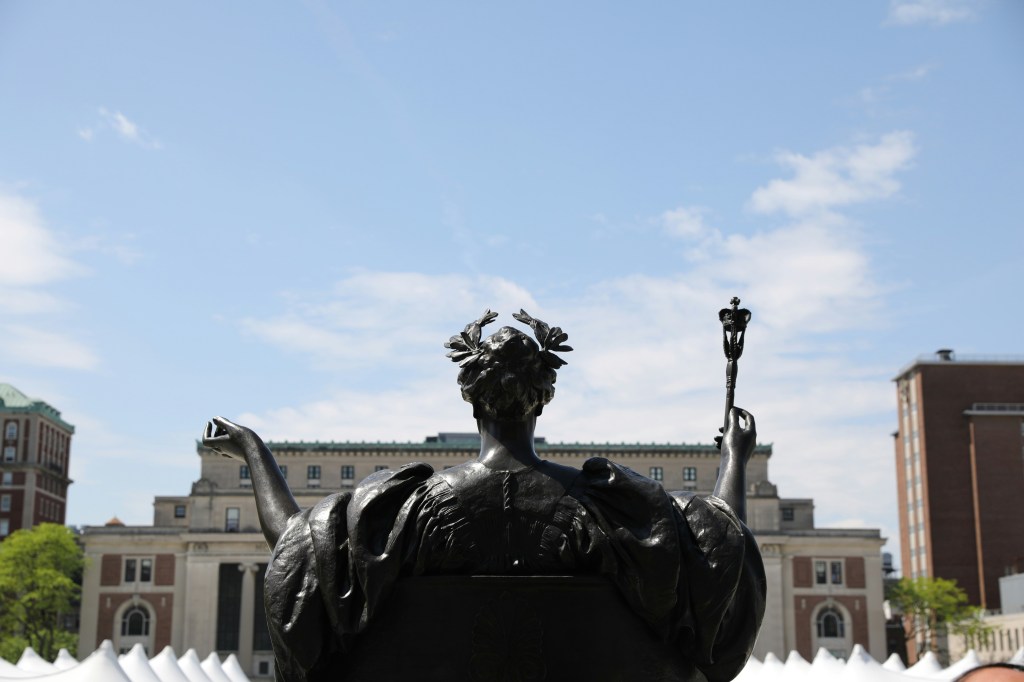
The slippery slope on which the board of Columbia University has stumbled since the start of the Gaza protests has turned out to be very steep, and the crash has been nothing less than spectacular. It also tells us something about the universities at large: the fall of the corporate governance of universities is final and fatal. While Karam and Vance have written about how Columbia’s “system of shared governance has cracked under the pressure of campus upheaval over the war in Gaza”, I will go one step further and argue that what we are seeing is the death of the corporate university, and as a university professor, I am glad for it, because a new kind of university is now needed.
The removal of Katrina Armstrong as Columbia’s president and the appointment of the co-chair of the board of trustees as acting president means that Claire Shipman is now the third university president since 2023. (Something similar has happened at The New School which is now on its third president since 2020.) This is, of course, a completely logical and unsurprising turn in a series of events which to me have demonstrated ever so clearly that the Columbia board has repeatedly not just neglected its fiduciary duties, at least since the start of the Gaza protests, but has in fact been in violation of them. While one could make a detailed case, a few simple things are clear as day. First, Columbia called the police – a heavily militarized police by the looks of it – on its own protesting students. Second, Columbia’s decision not to “divest from Israel” created real reputational, legal and financial risks for the university. Third, the university sanctioned its students in a heavy-handed manner. (The list could go on and on, but it is clear that Columbia was also happy to erode its goodwill. The crisis at Columbia has also spilled over to places like Davidson College, where “[a] group of Davidson College alumni and students have published a petition demanding the removal of Barnard Dean Leslie Grinage, who graduated from the college in 2003, from Davidson College’s board of trustees.”)
Steps as serious as these likely couldn’t have been taken without the support – tacit or otherwise – of the board, which can consequently be held responsible for having failed in its duties of care, loyalty and prudence. Thus, it is a surprise to me that (to the best of my knowledge) no major legal action has been taken against the board of trustees. The dysfunction of governance at Columbia has been so awesome as to rival the dysfunction of the UK government and the revolving door at 10 Downing Street. And of course it has not been the only US university to take such steps in response to protests and calls for divestment.
Just as the international non-response to the genocide in Gaza had led to the breakdown of the myth of an international rules-based order, I would argue that the Columbia board’s actions have led to the destruction of the corporate governance model as it is applied to universities and universities will ultimately be better off for it. The illusion has been cast off. There will be no more hiding behind the supposed virtues of corporate governance. Universities will either stick to corporate governance and die with it, or they will accept that corporate governance is fundamentally in contradiction with the true spirit and purposes of higher education. The latter will of course force universities to undertake an accounting of their successive failures and missteps, become in touch once again with their purpose and find a way of organizing themselves which is consistent with that purpose.
Being based in the Global South, the lessons our own universities here will glean (or not) from the Columbia episode are of immense interest and importance. American universities have been our spiritual center for some time, and for many of us educated in the heart of empire, the fall of our spiritual Vatican will be too disturbing to witness. Universities in the Global South, such as the one where I’m employed, are now in a real pickle. There is a non-trivial, consequential choice to be made about the future of the university. Universities can go on pretending that nothing of note has happened, and that the governance model works just fine, that the present dysfunction at Columbia is simply accidental and not the logical result of running a university like a corporation in a larger capitalist structure. This decision, as likely as it seems to me, will turn our universities into the dog sitting in a room on fire saying, “this is fine”. It will, in other words, turn us into a laughable meme.
The fact is that many students and faculty are already deeply disillusioned with universities – a process which has only been hastened through the tumult of the pandemic and which is now in another phase altogether with the tame surrender at Columbia in the face of a techno-fascist government. The capitalist economy whose praises have been sung in our university classrooms for decades has simply not delivered, and the economic pressures have been enough to draw attention to the fact that our prevailing global economic system was never about shared prosperity to begin with. Thus, the corporate university has been exposed for what it is: capitalism’s unreliable narrator. Students have been left feeling abandoned by an institution that promised so much and delivered so little, torn between jumping ship and finding other avenues to social mobility and status, and yet wanting to retain the old markers of competence and employability. (See Umair Javed’s Dawn op-ed on the crisis of the Pakistani middle class.) A foot in the old world and a foot in the new, students find themselves on uncertain, shifting ground. Professors too have been left feeling like fools, on the one hand knowing exactly what our employer is and hence tempted to bite the hand that feeds us, especially because like the system it serves the university increasingly offers little more than scraps and asks us to pretend that we’re being served a scrumptious banquet. On the other hand, we risk getting kicked to the curb; or worse, if the university decides to go all in on collaborating with the “hard state”, we risk being put down.
And that risk is very real in a place like Pakistan where universities, including my own employer, are for all practical purposes ultra-conservative in the sense of being subservient to military and political authorities irrespective of outward commitments to liberalism and public claims of providing a liberal arts education – whatever that means in a time when liberalism has all but proven useless in addressing some of the central problems of the day. The director general of ISPR, the former chief of army staff, and caretaker prime minister Kakar had no business being invited to LUMS under the pretext of “engagement” with students. Yet our universities have time and again provided platforms to military officials (or military backed politicians like Kakar). Beyond surface level displays of liberalism and progressive movements which are largely run independently by students and some faculty, our universities generally remain bastions of conservatism.
The question now is whether another kind of university is possible besides the corporate form. Are other models available or is there now a vacuum in the space for ideas about how we should organize higher education? Any alternative to this zombie regime of university governance would, I think, require at least an acknowledgment of the fall of our spiritual Vatican, no matter how badly it will throw us into treacherous, uncertain waters. In the words of Randall Bausor, “[a]n uncertain future lodges both novel adventures and feared catastrophes within the soul.” The issue of course is that the future is uncertain whether we like it or not, and universities like the wider world are already in the middle of an unfolding catastrophe. An acknowledgement will at least bring the prospect of a novel adventure rather than ensuring a dull, destructive, hollow commitment to a dead ideal. For many of us who committed ourselves to universities for reasons to do with the human spirit, the prospects of a novel adventure and a better future matter far more – and are simply far more interesting and attractive – than the idea of deluding ourselves. As far as this professor is concerned, a novel adventure it must be, for the corporate university is dead and buried on the Columbia campus.
 Daniyal Khan