Artificial intelligence (AI) is many things: a fear, an ambition, a fantasy, a site of conflict, a financial bubble, and an ideological battleground. But right now I can’t help but feel that it is a very important unfolding story about humanity. Of course there are many storytellers with as many stories to tell about AI. Some have told the story masterfully. For example, it was told so simply and briefly, yet so beautifully, by Laurence Fishburne’s Morpheus. It seems we didn’t listen very well. Others like the AI tech bros missed the point altogether.

Let’s look at AI as a financial phenomenon first. There is little doubt about AI being a complex bubble. Those denying that it is a bubble are deluded, because even Sam Altman – the man at the center of it all – has admitted it (or as much as he can or will publicly). Things are at the point where he is now having to do damage control after the OpenAI CFO Sarah Friar “said at a Wall Street Journal event on Wednesday the government could provide “the backstop, the guarantee that allows the financing to happen” alongside an “ecosystem of banks [and] private equity”.
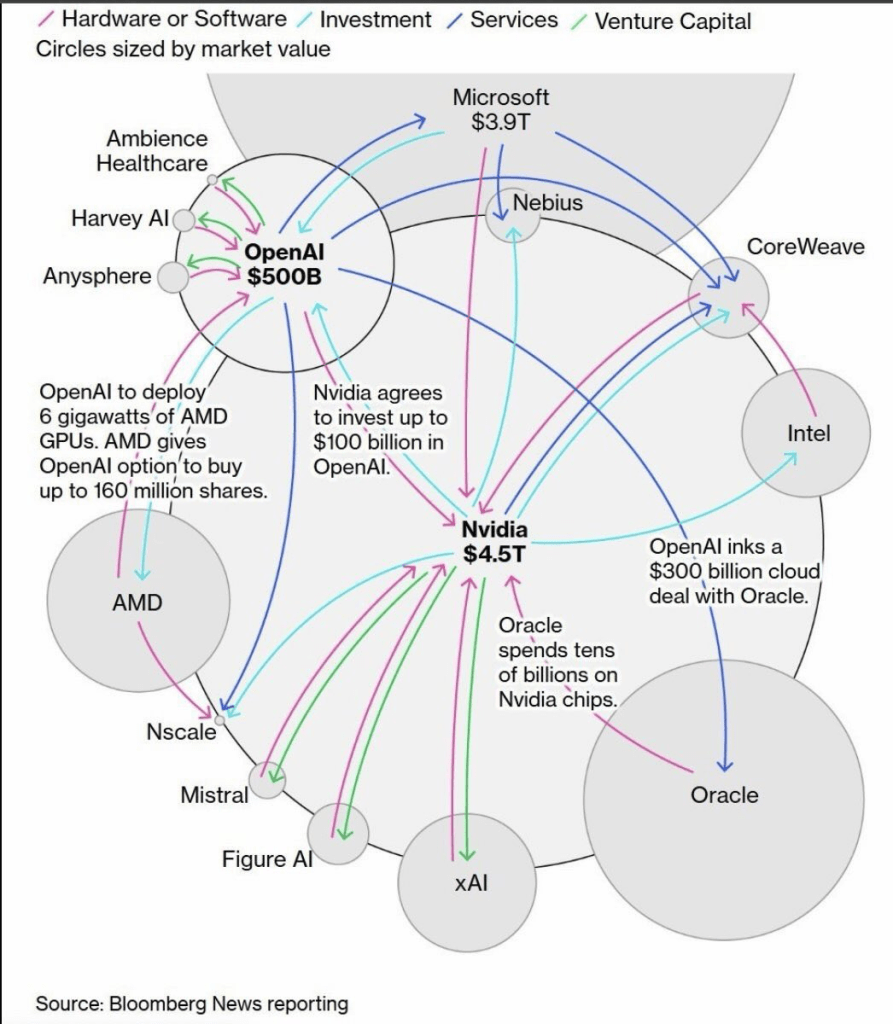
The bubble being recognized for what it is has got the AI tech bros unsettled and rattled. Altman’s “enough” in the interview with Brad Gerstner was telling. (If he wants to see short sellers get burnt, he should go public, but for now IPO plans are off the table, according to Friar.) Palantir CEO Alex Karp in his CNBC interview was even more rattled, calling people betting against AI (such as Michael Burry) “batshit crazy”. Things are unravelling with every passing day. Deutsche Bank is also considering shorting AI, and the NVIDIA CEO is going around stoking fears about China and trying to manipulate the market (as well as the US government) into supporting AI. The trouble for the AI tech bros is that the returns are simply not there: “Despite $30–40 billion in enterprise investment into GenAI, this report uncovers a surprising result in that 95% of organizations are getting zero return.”
The AI tech bros, in the habit of telling tall tales, are feeling the heat.
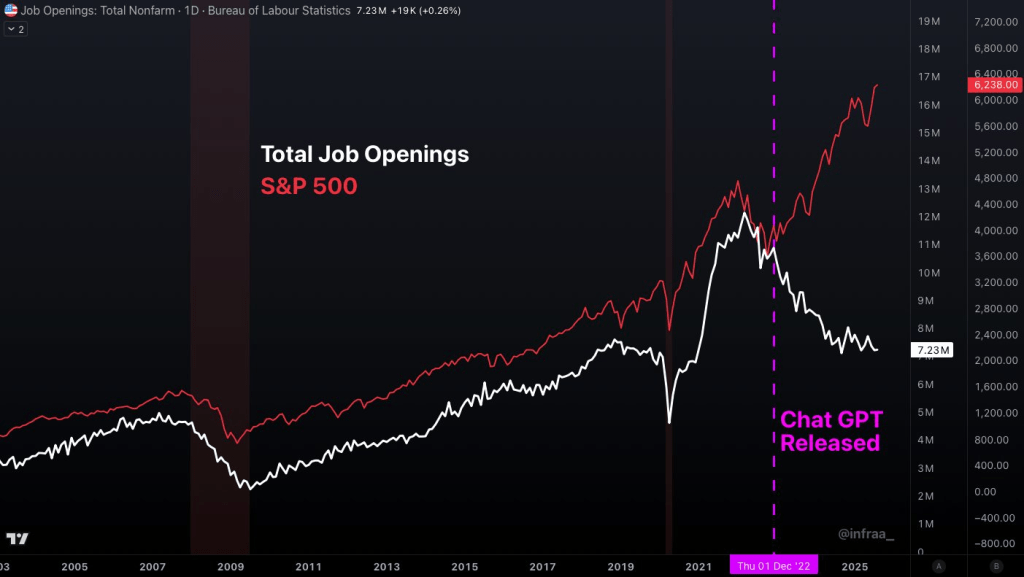
And at the same time, the impact on labor markets, even if it turns out to be temporary in some way (and hopefully it does), is undeniable. This is borne out in the data, such as the chart above, as well as anecdotally. (A friend tells me he’s doing the job of 5 people using AI ever since 4 of his colleagues who adapt to AI were fired.) The question with AI, as with so many other capitalist technologies and as with capitalism in general, is not whether it is going to be sustainable, but tolerable.
I do think that the US government will provide support to the AI sector as it wants. They are politically invested in it, with Palantir for example. The US government (or the central monetary authority for that matter) is not doing its Keynesian job of smoothing the cycle. If they were interested, they would have nipped AI’s carnivorous flower in the bud. They have forgotten the Minskian lesson that capitalism can survive inequality, but it cannot survive volatility:
“It may also be maintained that capitalist societies are inequitable and inefficient. But the flaws of poverty, corruption, uneven distribution of amenities and private power, and monopoly-induced inefficiency (which can be summarized in the assertion that capitalism is unfair) are not inconsistent with the survival of a capitalist economic system. Distasteful as inequality and inefficiency may be, there is no scientific law or historical evidence that says that, to survive, an economic order must meet some standard of equity and efficiency (fairness). A capitalist economy cannot be maintained, however, if it oscillates between threats of an imminent collapse of asset values and employment and threats of accelerating inflation and rampant speculation, especially if the threats are sometimes realized. If the market mechanism is to function well, we must arrange to constrain the uncertainty due to business cycles so that the expectations that guide investment can reflect a vision of tranquil progress.” – Minsky, Stabilizing an Unstable Economy (1986 [2008]), Ch 1, pg 6]
My inner anarchist says “good riddance, let it burn”, but the inner social scientist recognizes that policy makers in both the government and at the Fed are going to swoop in when the market crashes, bail out the big boys, and leave the little guy holding a bag of dirt out on the road. All the while, they’ll tell a story about how they learnt the lessons from past crises and from financial history and acted accordingly. A few years down the line, someone might even get a Sveriges Riksbank Prize (the economics “Nobel”) for writing a 3-variable equation meant to formalize the absolutely deranged, sociopathic behavior and decisions of the AI tech bros and their role in the story of the AI bubble and crash.
That brings us to the pathologies of the AI tech bros. These people are basically misanthropes. They hate humanity and hate that nobody loves them. They are desperate to be loved, to be seen and to be heard. They fantasize about living on Mars and build their own private towns in the meantime. Their vision is of a world in which there is neither any need nor any desire for humans – or humanity. Everyone is told that those who don’t adopt their AI tools “will be left behind” – as if they actually want to take everyone along! But nobody really will be left behind, because the system doesn’t believe in leaving anybody alone. Everyone must adopt the ideologies of progress, development and consumption – those who do not do so willingly will be made to do so by force (see colonialism, imperialism and “development”). Left behind? You and I will be tied to the back of a Tesla with the noose around our necks and dragged along if the system has its way. The system is totalitarian in its foundations and institutions, and everything else is, as the AI tech bros say, a wrapper.
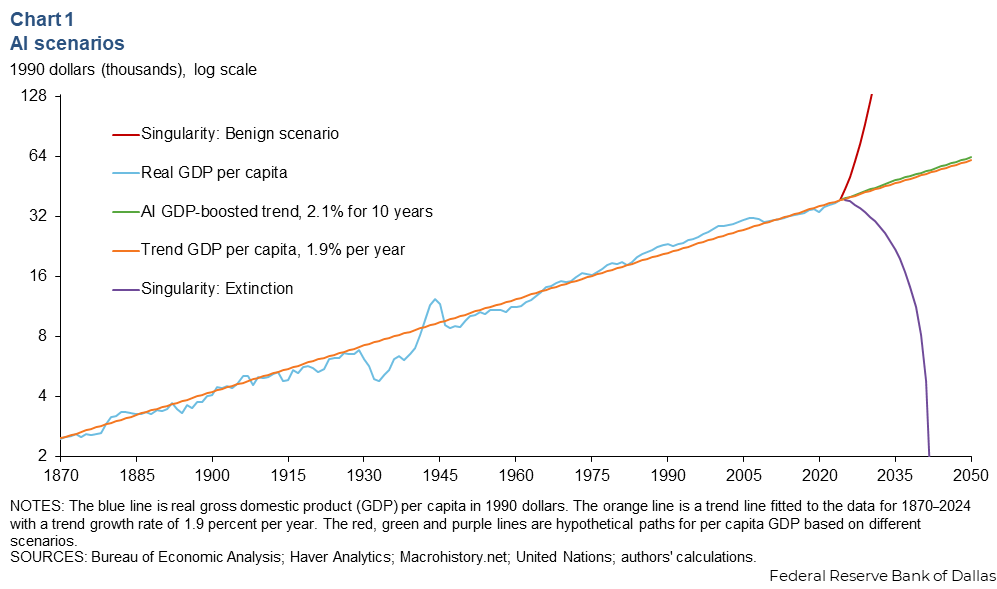
It is important to see clearly where this group fits into the cultural landscape. These people lack even the comprehension skills and the intelligence to make basic distinctions between the heroes and the villains in stories such as the Lord of the Rings, and they have simply not been able to learn the lessons of such culturally significant, consequential and influential science fiction stories as The Matrix. They imagine themselves to be Neo or Morpheus, but are in fact Cypher – human traitors who think the machines superior and smarter, and the dream-world of the matrix preferable to reality. (Interestingly, researchers at the Dallas Fed have explicitly acknowledged the possibility of extinction as the end of the AI story. See chart above.) They are proud to call themselves “Palantir”, after a fantastical device through which one can carry out surveillance and exercise malicious influence, and Musk thinks of himself as the guy who’s saving the stupid hobbits, while actually being a certified fascist.

Misreading popular culture, being insensitive to the dominant mood, an inability to read the room, desperate to be seen and heard – sounds familiar? Funnily enough, that is not far from a description of many university academics, and might go some way to explaining why it is that universities were so quick to let the AI genie into their house. University administrative staff, faculty, and students alike have been happy to surrender their cognitive capacities to AI, something they might come to regret to the extent that AI will turn out to be a fad and a disastrous financial mania. But universities didn’t resist when they could have, and they got carried away.
The way universities have just invited in AI was not inevitable at all, but they just assumed that this is something here to stay, and didn’t bat an eyelid when Microsoft put a Copilot button in everyon’e Outlook interface. Rather than relying on our own tools and systems, we were happy to let the corporations sink into our roots (a phrase which in Urdu is far more powerful – جڑوں میں بیٹھ جانا). Ultimately, a sector obsessed with austerity measures, the bottom line, and with the capitalist corporate ethos of efficiency even as it made claims about knowledge and education, was never going to be able to put up a proper fight.
But the AI story isn’t over yet. It might be some time before it happens, but I for one look forward to the bursting of this festering, pus-filled boil of a bubble.
Postscript: To their credit, regardless of their many problems, The Economist was rightly already asking around this time last year if the AI bubble might burst in 2025.
 Daniyal Khan